
 EN
EN

Recent Trends in PET Preform Injection Molding Machines: Efficiency, rPET and Smart Production Take the Lead
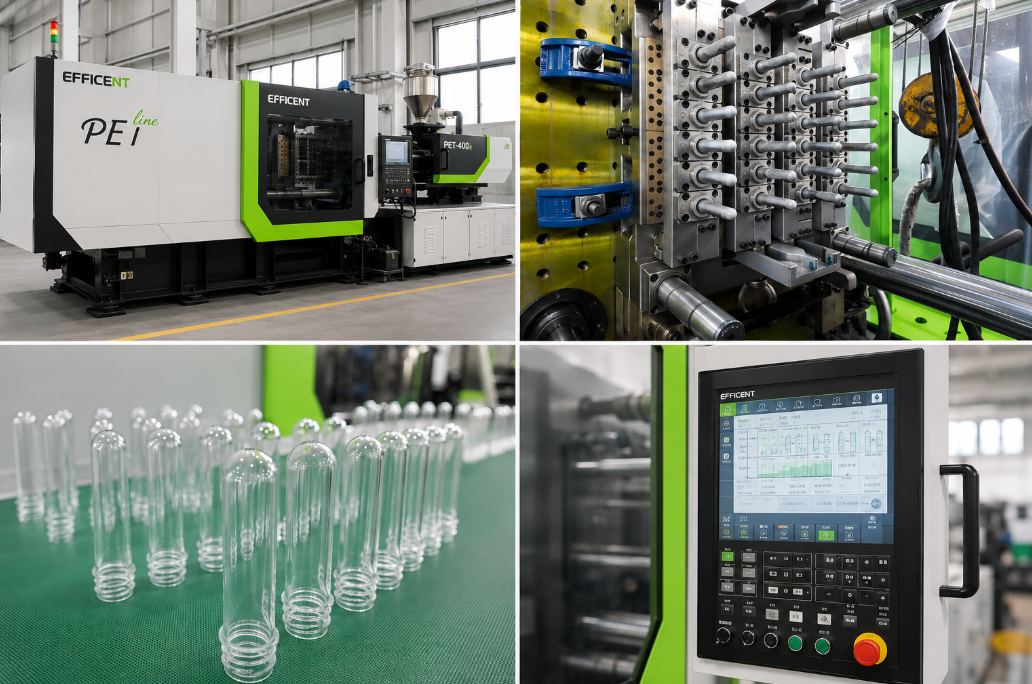
The PET preform industry has been moving quickly over the past year. For beverage, food, personal care and pharmaceutical packaging producers, the focus is no longer only on machine tonnage or cavity numbers. Buyers are paying closer attention to the complete production performance: cycle time, energy consumption, preform quality, material flexibility, mold stability and long-term operating cost.
Recent industry news shows a clear direction. PET preform injection molding machines are becoming faster, more integrated and more intelligent. At the same time, the use of recycled PET is pushing machine manufacturers to improve drying systems, plasticizing units, temperature control and quality inspection. For factories that want stable mass production, the machine is no longer just a single piece of equipment. It has become the core of a complete production system.
One of the most important trends is high-efficiency production. In the past, many customers compared machines mainly by clamping force and price. Today, the real question is how many qualified preforms can be produced per hour, and how much electricity, labor and maintenance cost are needed for each preform. A machine with a slightly higher initial price may still be more competitive if it offers shorter cycles, lower scrap rates and better long-term stability.
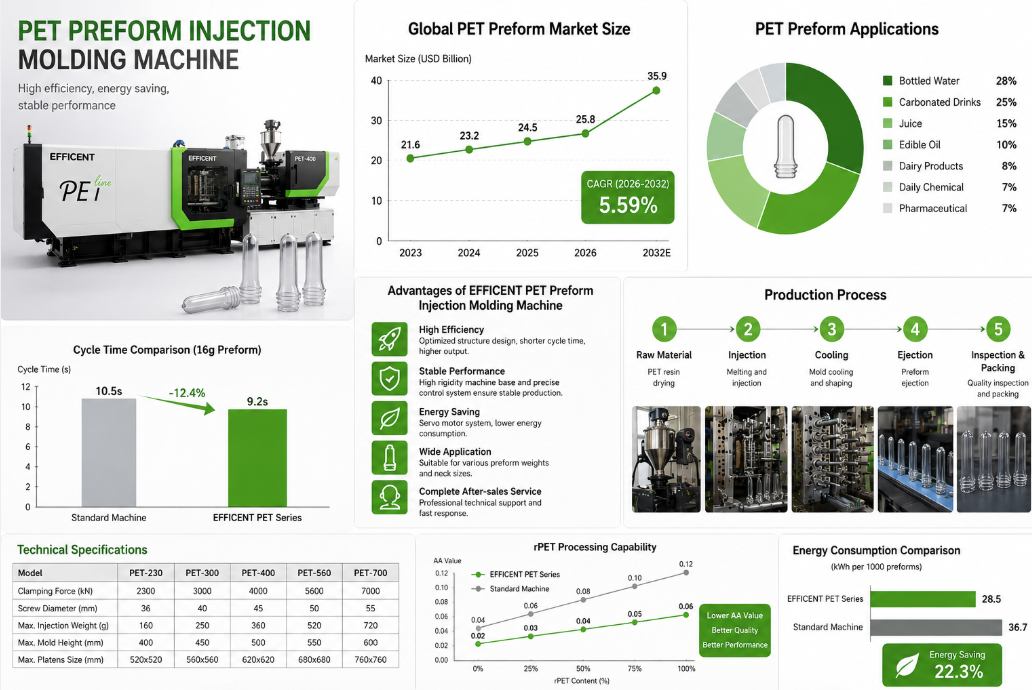
For PET preform production, even small improvements in cycle time can make a big difference. When a factory runs 24 hours a day, reducing the cycle by half a second or one second can bring a significant increase in monthly output. This is why modern PET preform injection molding machines are designed with faster injection response, optimized cooling systems, stable mold opening and closing, and efficient preform take-out solutions.
Another major topic is rPET processing. More brands are increasing the recycled content in their packaging, especially in bottled water, carbonated drinks and daily-use packaging. This creates new challenges for injection molding equipment. Compared with virgin PET, recycled PET may have more variation in moisture, viscosity, color and contamination level. If the machine and auxiliary systems are not well matched, the final preforms may show yellowing, black spots, unstable weight, poor transparency or inconsistent blow molding performance.
Because of this, PET preform production lines now require better material drying and plasticizing control. A good PET preform injection molding system should help reduce moisture-related defects, keep the melt stable and protect the quality of the preform during continuous production. For customers using recycled PET or mixed materials, the machine supplier’s experience becomes especially important. It is not only about selling the machine, but also about helping the customer set up the right process.
Digital production is also becoming more common. Many new PET preform injection molding systems now include real-time monitoring of temperature, pressure, cycle time, energy use and alarm records. This helps factory managers understand the real production condition instead of relying only on manual checks. When production data is recorded clearly, it becomes easier to find problems, improve process settings and reduce unexpected downtime.
For large preform factories, this is very valuable. A small process change may affect thousands or even millions of preforms. If the machine can provide stable data and early warnings, the factory can react faster before a quality issue becomes a serious production loss. This is why smart control panels, remote diagnosis and production data management are becoming important selling points in the PET preform machine market.
Quality control is another area receiving more attention. A preform may look normal after injection molding, but its internal stress, temperature history or weight distribution can still affect the blowing process. If the preform is not stable, the final bottle may have uneven wall thickness, poor strength or deformation. For this reason, producers are paying more attention to preform consistency, not only visual appearance.
This also explains why mold quality is critical. In PET preform production, the injection mold directly affects cooling efficiency, preform weight accuracy, neck finish quality and cycle stability. A high-cavity mold must run smoothly for long periods without frequent maintenance. For high-output production, the mold and machine need to work as one complete system. If the machine is stable but the mold cooling is poor, the cycle will still be slow. If the mold is good but the injection unit is not accurate, the preform quality will still fluctuate.
From the market side, demand for PET preforms remains strong. Bottled water, soft drinks, edible oil, juice, dairy products, household chemicals and pharmaceutical packaging all continue to use PET containers. In many developing markets, bottled drinks and packaged consumer goods are still growing. This creates opportunities for both large factories and new investors who want to enter PET preform production.
For buyers, choosing the right machine should not be based only on the quotation. A more practical comparison should include several points. First, whether the machine is designed specifically for PET preforms, including screw design, injection capacity and cooling efficiency. Second, whether it can work with the required mold cavity number and preform weight. Third, whether the supplier can provide complete support, including mold, chiller, dryer, loader, robot and process training. Fourth, whether the machine has proven stability in long-term production.
For manufacturers and exporters of PET preform injection molding machines, the market message is also clear. Customers want reliable production, lower unit cost and easier operation. They need machines that can handle both virgin PET and recycled PET, maintain stable quality and reduce waste. They also expect faster after-sales service, spare parts support and technical guidance.
In the coming years, PET preform injection molding machines will continue to develop toward higher speed, lower energy consumption and smarter production management. The competition will not only be about machine appearance or basic specifications. The real advantage will come from complete system capability: machine, mold, auxiliary equipment, automation and process know-how.
For packaging producers, investing in the right PET preform injection molding system means more than buying equipment. It means building a stable production base for future orders, new bottle designs and changing material requirements. As the packaging industry keeps moving toward lightweight bottles, recycled materials and cost-efficient production, PET preform injection molding machines will remain one of the key technologies behind modern plastic packaging.