
 EN
EN

96-Cavity PET Preform Injection Molding Project in Malaysia
In PET preform production, customers are always focused on three key factors: efficiency, stability, and long-term operating cost. A recent 96-cavity project we completed in Malaysia is a good example that reflects these priorities in real production conditions.
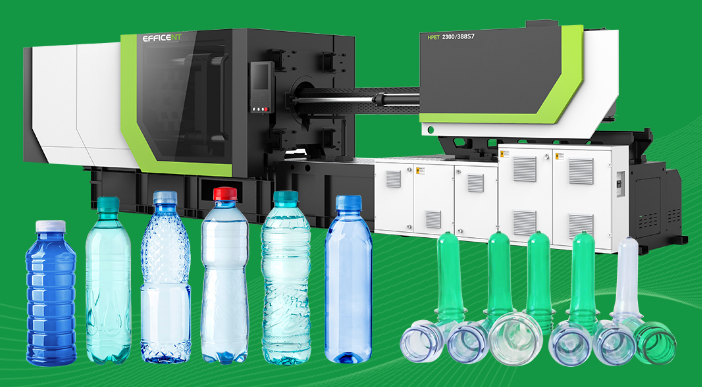
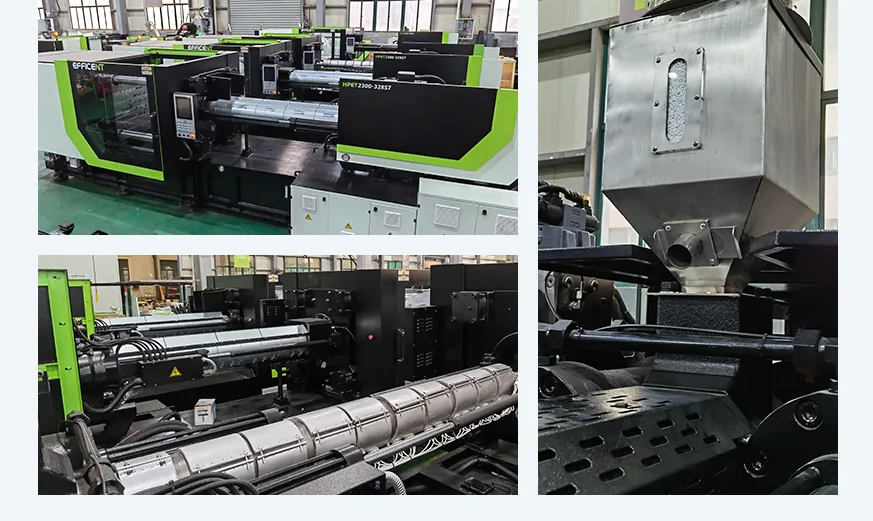
This project is equipped with our HPET3100-488 injection molding machine, running with a 96-cavity hot runner mold. The product is a 3025 neck preform, 9g weight with 2mm wall thickness, mainly used for drinking water packaging. From installation to stable mass production, the entire process was smooth and met the customer’s expectations.
1. Site Conditions and Machine Performance
The factory is located in Malaysia, where the ambient workshop temperature is around 31°C, representing a typical hot and humid environment. In addition, the cooling water condition on site is relatively basic, with water pressure at about 3 bar, which is not considered ideal.
Under these conditions, the system achieved a stable cycle time of 14.43 seconds (including 1.8 seconds for robot take-out), and has been running consistently at this level. For a 96-cavity system, this level of stability is particularly important.
The cycle time breakdown is as follows:
- Mold close: 1.42 s
- Injection: 3.00 s
- Cooling: 5.00 s (plasticizing: 4.76 s)
- Ejection/return: 0.90 s
- Delay: 0.50 s
- Robot take-out: 1.67 s
- Mold open: 1.64 s
The sequence is well-balanced, with no obvious idle time between steps, showing strong coordination between machine movements and process control.
2. Key Advantages Demonstrated
This project clearly highlights several strengths of our PET preform injection molding system.
2.1 Stable and Efficient Cycle Control
Running a 96-cavity mold at around 14 seconds requires high machine rigidity, fast response, and precise system matching.
In this case:
- Injection time is controlled within 3 seconds
- Cooling time is only 5 seconds
- Plasticizing overlaps efficiently with cooling
This indicates stable melt preparation and good thermal balance, without delays or overcooling.
2.2 Well-Matched Plasticizing System
The plasticizing time is 4.76 seconds, slightly shorter than the cooling time. This is an ideal condition in production because it ensures:
- No waiting for material
- Stable melt temperature
- Reduced risk of material degradation
This reflects proper screw design, heating configuration, and drive control, especially suitable for lightweight 9g preforms.
2.3 Adaptability to Standard Cooling Conditions
Even with only 3 bar water pressure, the system maintains a 5-second cooling time and smooth demolding.
This is particularly important for customers in regions such as Southeast Asia, the Middle East, and Africa, where cooling infrastructure may be limited. The machine does not rely on high-end utilities to deliver stable performance.
2.4 Smooth Motion Coordination
From the cycle breakdown:
- Mold open and close total about 3 seconds
- Ejection and delay are controlled within 1.4 seconds
- Robot take-out is well synchronized at 1.67 seconds
There is no unnecessary waiting between steps, which improves overall efficiency and reduces energy consumption.
2.5 Stable Operation in High Temperature Environments
An ambient temperature of 31°C can negatively affect mold temperature control and product consistency.
However, in this project:
- Cycle time remains stable
- Demolding is smooth
- No sticking or stringing issues observed
This demonstrates good thermal management and reliability for long-term operation in tropical climates.
3. Value for the Customer
From the customer’s perspective, the benefits are clear:
Consistent and predictable output
A 14-second cycle with 96 cavities delivers high daily production with minimal fluctuation.
Reduced dependency on utilities
Stable performance even with basic cooling conditions lowers infrastructure investment.
Lower maintenance and adjustment effort
The system is well-matched, requiring minimal fine-tuning during production.
Support for lightweight production
The 9g preform helps reduce raw material consumption while maintaining product performance.
4. Conclusion
This 96-cavity PET preform project in Malaysia demonstrates stable mass production under real-world conditions, achieving a 14.43-second cycle time despite high ambient temperature and average cooling water pressure.
It reflects the overall capability of the system in machine design, plasticizing performance, and process control.
For customers planning to invest in 96-cavity or higher-output PET preform production, this case provides a practical benchmark. The system is suitable for a wide range of applications, including drinking water, edible oil, and other packaging needs, with flexible configuration options based on different product requirements.
If you are evaluating a new preform production line, this project offers a clear and reliable reference.